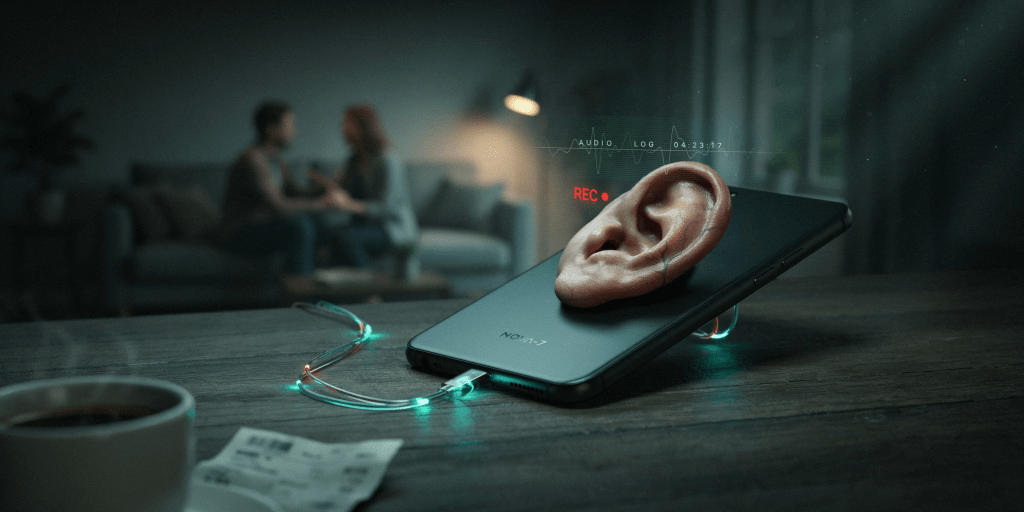
There is a conversation almost everyone has had at some point, always in that same tone, somewhere between a joke and genuine paranoia. You are talking to your partner about buying diapers because the baby now weighs about as much as a bag of cement. You do not search it on Google. You do not open a single store online. You just say it out loud, phone sitting six inches from your face while you scroll through nothing in particular on the couch. And the next day, sometimes that same afternoon, there it is: Huggies, Pampers, some diaper brand you did not even know existed, taking over your entire feed as if it had been waiting for the exact right moment to show up.
Swap diapers for vacation and the pattern repeats with almost comic precision. You mention Portugal on a phone call and suddenly Booking is chasing you across the internet for two weeks. You complain that you need new running shoes because yours smell like a crime scene, and without searching anything, ads for Nike, Adidas, some running brand you discovered three years ago and swore never to mention out loud again start showing up. The feeling is so constant, so consistently reported by people who have never met each other, that it has become a kind of shared digital folklore: our phones are listening to us. There is no other explanation. It is too much of a coincidence to be a coincidence.
And here is where things get uncomfortable, because it means contradicting collective intuition without sounding condescending. The short answer, the one given by Google, Meta, Apple, and pretty much every engineer who has ever worked near an ad system, is no, your phone is not recording your conversations to sell you diaper ads afterward. Meta has repeated for years that it does not use a phone’s microphone to inform ads, and that ads are based on people’s interests and profile information, not on what is said out loud. Apple and Google claim essentially the same thing: microphones only listen continuously for wake words like “Hey Siri” or “Okay Google,” and the rest of the ambient audio is neither recorded nor sent to any server for advertising purposes.
The long answer, the one that actually matters, is that this denial is not reassuring at all. It is more unsettling than the spy-microphone theory, because it means machines do not need to hear you to know what you are about to need. They already know you well enough without doing that.
Why the microphone theory does not survive a technical exam
Before getting to the more interesting part, which is why advertising seems psychic without spying on you through the microphone, it is worth understanding why the theory of constant mass listening does not hold up technically, even though there is one real exception worth knowing about.
Recording and transmitting audio continuously from millions of phones is an absurdly expensive operation. It requires processing audio in real time, converting it into text or some semantic representation, filtering out ambient noise, identifying who is speaking, uploading all of that to a server, and doing it without any noticeable hit to battery life or data usage. Anyone who has used a voice assistant knows that activating and processing audio drains battery in a way you can feel. Doing that twenty-four hours a day for hundreds of millions of devices, without anyone catching it in data consumption or independent security audits, is a scale of operation that would leave a technical trail impossible to hide. Mobile operating systems also require explicit permission for microphone access, and that access leaves visible traces within the system itself.
Now, the exception worth mentioning because it is real and worth knowing about does exist, and it has a name. In 2024, an internal document from Cox Media Group, a media and advertising conglomerate, leaked to the press describing a product called Active Listening. That document explained thatthe tool used smart devices capable of capturing real-time intent data by listening to conversations, which was then combined with behavioral data to identify consumers ready to buy. The same document listed Google, Meta, and Amazon as clients of the company. All three flatly denied having taken part in that specific program: Amazon said it had never worked with Cox on this, Meta insisted it does not use the microphone for advertising, and Google removed Cox Media Group from its partners program within days of the leak becoming public.
The case is revealing for two opposite reasons. On one hand, it confirms that yes, technically, there are actors in the ad ecosystem who have tried to build products based on active listening through smart devices, which validates part of the collective fear. On the other hand, the immediate reaction from the big platforms, which rushed to publicly cut ties with the company in question within a matter of days, suggests that this kind of practice is exactly the sort of legal and reputational risk no major company wants anywhere near its name. Not because they are angels, but because they already have a far more efficient, legal, and cheap way of achieving the same result.
And that efficient way is the part we should actually be worried about.
The real mechanism: they do not need to hear you, they already know who you are
Here is the uncomfortable twist in the story. Platforms do not need your voice because they already have something far more useful: your entire behavior, accumulated over years, cross-referenced across dozens of sources you probably do not even remember using.
Think about everything a phone knows about you without recording a single word. It knows where you have been, because GPS tracks your location constantly and that location gets shared with dozens of apps that use it for seemingly innocent functions like showing the weather or calculating a route. It knows what you have searched on Google, what you have looked at on Amazon even without buying anything, how long you lingered on a TikTok about running shoes before swiping to the next one. It knows who you interact with on social media and what kind of content those people consume, because recommendation systems do not just model you, they model your entire network of contacts and friends, and use that network to infer shared interests.
On top of that, add an entire market, gigantic and largely invisible to the average user, called data brokers. Companies that specialize in buying, cross-referencing, and reselling behavioral data aggregated from thousands of different sources: supermarket loyalty cards, anonymized browsing histories, health and fitness app data, online purchase records, insurance information. That data gets combined to build a probabilistic profile of each person that turns out to be astonishingly accurate, not because someone overheard you talking about diapers, but because thousands of people with a demographic profile similar to yours, in circumstances similar to yours, already showed the same behavioral pattern before you did.
This is the key that explains the diaper case better than any hidden-microphone theory. If you are between twenty-eight and thirty-eight years old, if your location shows you have recently visited a pharmacy, a hospital, or a baby goods store more often than usual, if your search pattern has shifted toward parenting-related content, if your frequent contacts on social media have started posting baby photos, the algorithm does not need to hear you say the word diaper. It already calculated, months in advance, the statistical probability that you were about to become a diaper buyer before you consciously knew it yourself. The vacation case works the same way: if you searched flights three weeks ago even without completing the purchase, if your calendar has an event called “family vacation” synced through Google Calendar, if your bank processed a deposit payment to a travel agency, Booking already knows you are in buying-decision mode long before you say the destination’s name out loud in front of your phone.
What feels like an impossible coincidence is, in reality, the result of a data surveillance system so extensive and so finely tuned that it no longer needs the extra step of listening. Modern advertising does not guess what you are about to say. It predicts what you are about to do, and sometimes it predicts it better than you do yourself.
The other character in this story: your own brain
There is a second part to this equation that almost nobody mentions because it is less dramatic than the spy-microphone theory, but it probably explains a huge chunk of those coincidences that feel impossible. It is called confirmation bias, and in its most specific form it has a curious name: the Baader-Meinhof phenomenon, also known as frequency illusion.
Here is how it works. The human brain is not built to count with statistical precision how many times it sees something. It is built to detect patterns that feel relevant and to remember them far more intensely than irrelevant ones. The moment you mention diapers in conversation, your brain becomes momentarily sensitized to that concept. Over the following hours or days, any diaper ad that shows up, even though it is just one among the hundreds of ads you scroll past every day without consciously registering them, is going to jump out at you in a way other ads do not. It is not that Huggies suddenly appeared more often than usual. It is that you, for the first time, are mentally primed to notice it when it does.
This is not an elegant way of saying advertising surveillance is a myth. We already established it is not. It is a way of understanding that two different phenomena happen at the same time and reinforce each other: on one hand there is a real, sophisticated, and largely invisible data profiling system that genuinely predicts your interests with unsettling accuracy; on the other hand there is a human brain that, once a topic gets activated, starts seeing it everywhere, feeding the sense that something paranormal is happening when what is actually happening is applied statistics plus some basic cognitive psychology.
A study published in the journal Social Media + Society in 2024, led by researchers from the United States, the Netherlands, and Poland, set out to map exactly this phenomenon, comparing perceptions of conversation-related advertising across countries with very different cultures around privacy and state surveillance, precisely to understand how much of this belief comes from real data-targeting experiences and how much comes from subjective perception and cultural context.
So, are they listening or not?
The honest answer, the one that does not fit in a clickbait headline, is that they are probably not listening in the literal sense most people imagine, unless you happened to get caught in some isolated and likely illegal experiment like Cox Media Group’s, whose real existence should be taken as a serious warning rather than a footnote. But they are watching you, in a far more complete, constant, and hard-to-avoid way than any hidden microphone could manage. They watch you through your location, your searches, your scrolling pauses, your network of contacts, your buying patterns, your calendar, your health apps, and dozens of data brokers you have never heard of and probably never will.
The right question is no longer whether your phone is listening to you. It is whether you are okay with it knowing this much about you without needing to.
If the idea bothers you enough to actually do something about it, the answer is not throwing your phone into the ocean in some dramatic gesture of digital detox. It is something far more boring and far more effective: check which apps actually have microphone access and revoke it from the ones that do not truly need it, turn off ad personalization in your Google and Meta account settings, and accept that the precise digital profile following you around the internet was not born from illegal eavesdropping, but from years of data you handed over yourself, one piece at a time, without ever noticing.

