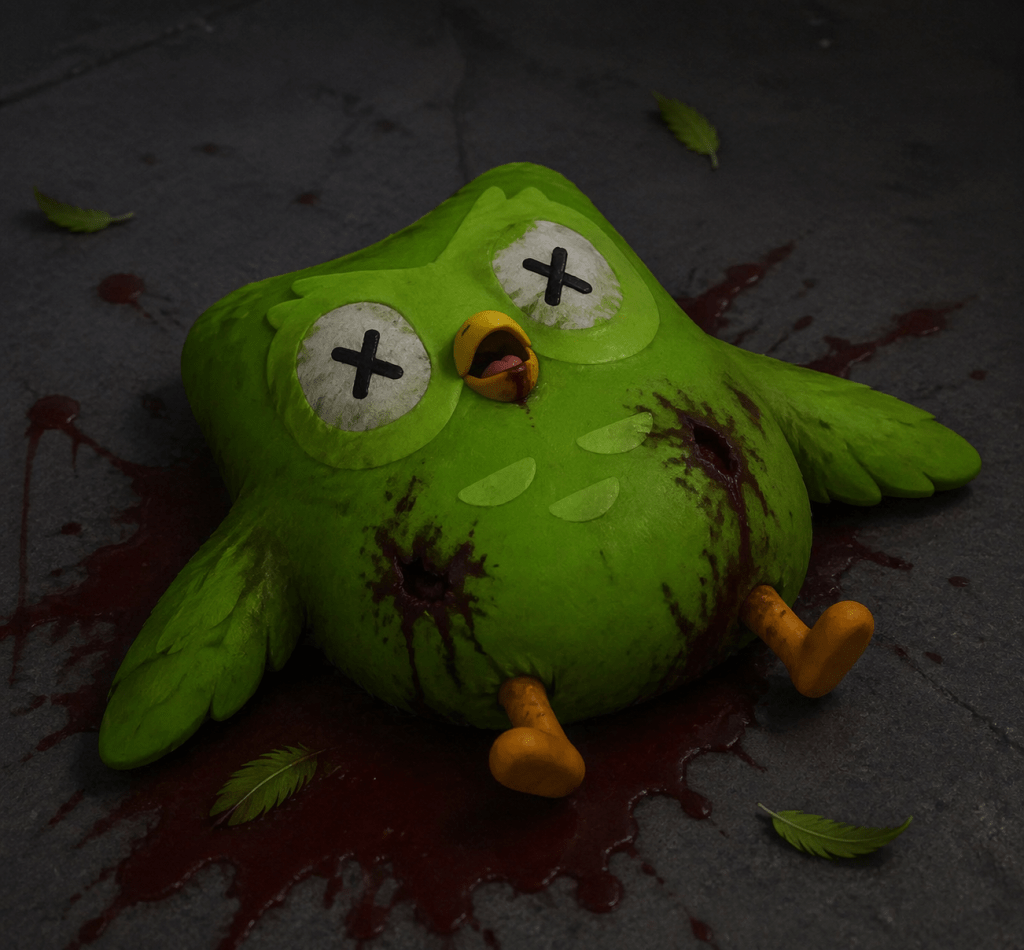
Duolingo killed its mascot. On purpose. And it became one of the most studied brand moments in recent memory — not for the shock, but for what happened next.
On February 11, 2025, Duolingo’s social channels went dark with a single image: Duo the Owl, eyes replaced by cartoonish X’s, lying flat. The caption was deadpan. The grief was performative. And the internet — completely — fell for it.
Within hours, verified brand accounts were leaving condolences in the comments. Within days, #RIPDuo had over 45,000 uses. Within a week, news coverage had gone from TikTok to NPR to The New Yorker. And somewhere behind all of it, a small social media team was doing something quietly extraordinary: they weren’t selling anything. They were just staying in character.
25,560% spike in online mentions on announcement day alone
1.7B impressions generated — 2× the top Super Bowl ads of 2025
450 editorial articles published about a cartoon owl’s death
This wasn’t a stunt. It was a character arc.
Most brands treat virality as a goal. Duolingo treats it as a byproduct. The “death” didn’t come out of nowhere — it came out of years of building Duo into a genuine internet personality: menacing, devoted, unhinged, and strangely lovable. By the time the fake funeral happened, the audience already had feelings about this bird. Strong ones.
“Make it fun. Make it weird.” — then the CEO pushed again: “Make it weirder.”
That’s the instruction that eventually produced the image of a lifeless Duo. The team had six days from brief to launch. They didn’t ask for a bigger budget. They didn’t wait for a media partner. They built a murder mystery — complete with a Cybertruck, a suspect reward, and a resurrection tied directly to user behavior in the app — in less than a working week.
The result? Duolingo added more daily active users in Q1 2025 than in any single quarter in its history.
The three things Duolingo got right that most brands get wrong
Lesson 01
They didn’t invent a new voice — they doubled down on the existing one
The campaign worked because killing Duo felt completely on-brand. Duo had been threatening users for years. His death was just the most extreme version of the same joke the brand had been telling all along. Brands that try to manufacture a new personality for a stunt usually fail because the audience doesn’t buy it. Duolingo’s audience had been buying Duo’s absurd energy for years — the stunt just turned up the volume.
Lesson 02
They made the audience part of the story
Duo’s resurrection wasn’t announced — it was earned. Users had to collectively generate 50 billion XP by completing language lessons to bring him back. This transformed passive observers into active participants. The brand didn’t just get impressions; it got behavior. That’s the difference between a campaign that gets views and one that gets results.
Lesson 03
They treated social media as the product, not the distribution channel
The senior social media manager, Zaria Parvez, has built Duolingo’s TikTok to nearly 17 million followers without a large team or a massive budget — because content decisions move on a two-day cycle without waiting for senior leadership sign-off. Speed and creative autonomy are the structural advantages most brands accidentally engineer out of their own teams.
But here’s the part the case studies leave out
By early 2026, Duolingo’s stock had fallen roughly 80% from its 2025 peak. User growth had slowed significantly in the back half of the year. The CEO acknowledged on a Q4 earnings call that daily active user growth had decelerated throughout 2025. The community had started pushing back on an “AI-first” strategy that many felt was optimizing for engagement metrics at the expense of actual learning.
The lesson there is just as valuable: viral moments can’t substitute for product substance. Duolingo built a spectacular brand machine — and that machine gave it extraordinary grace with its audience. But when the product itself started to feel less trustworthy, no amount of charismatic marketing could fully compensate. Brand personality earns you more runway. It doesn’t replace the runway.
Clarity of identity is what turns a bold idea into a believable one. The risk wasn’t killing the mascot — it was everything that had to be true about the brand before that moment could land.
What this actually means for your brand
You don’t need a mascot. You don’t need a Cybertruck. What you need is a clear enough identity that your audience would recognize your content even without your logo on it. Duolingo passes that test easily. Most brands fail it immediately.
The question to ask isn’t “what bold thing can we do?” The question is: “do we know ourselves well enough that a bold thing would feel inevitable rather than desperate?” Duolingo’s answer was yes. And a cartoon owl’s funeral became a masterclass in brand strategy.

