There’s a specific moment in any creative project where the concept either holds or collapses. You’ve built the framework, you’ve written the manifesto, you’ve convinced yourself it makes sense — and then you have to make the actual thing.
With NØRR, that moment happened somewhere between the fourth single and the EP.
I’m not going to pretend this is a conventional music story. NØRR is a dark electronic project that I run out of Madrid, released under República Independiente, and built deliberately as a proof of concept: what happens when you use AI not as a shortcut but as a strategic collaborator in the full creative process — from concept to distribution to narrative.
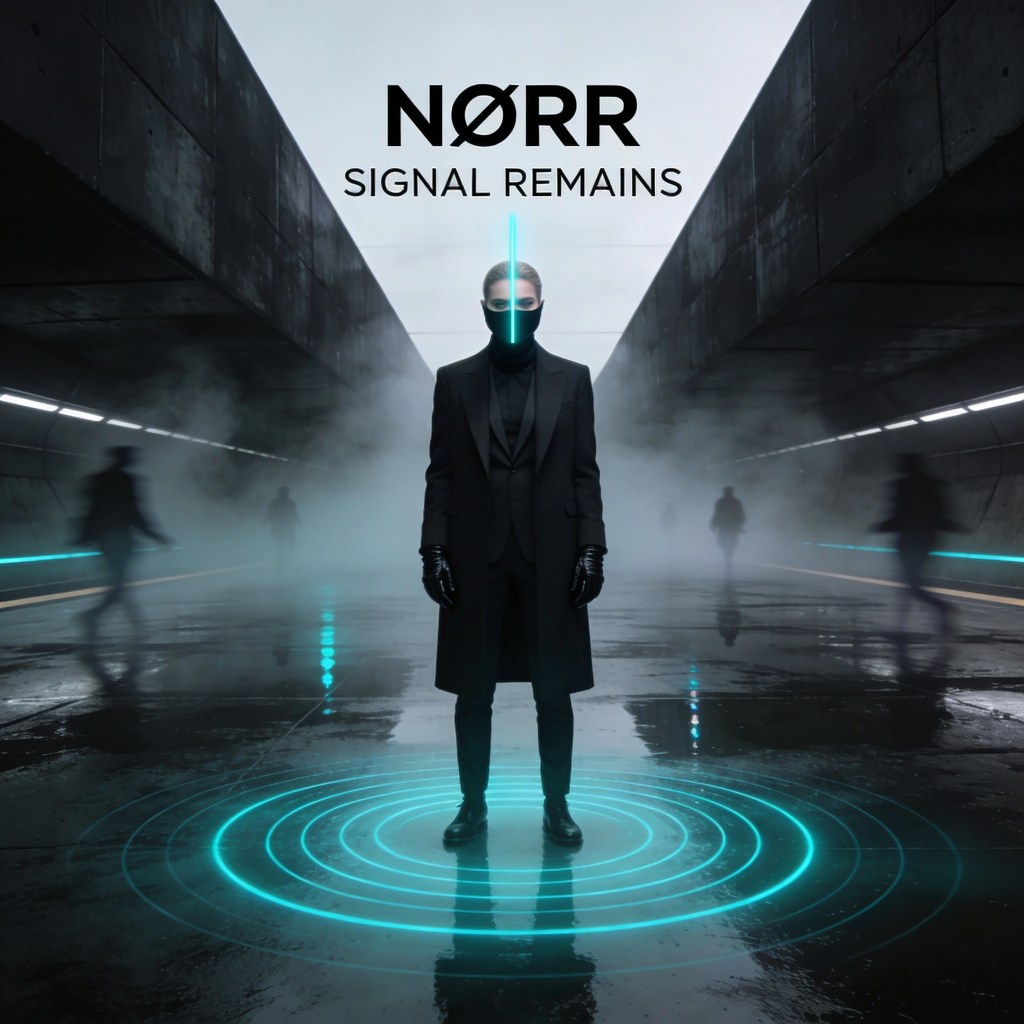
SIGNAL REMAINS, out May 15, is the first release after The Signal EP. And it’s the one that made the system real.
Why I Built NØRR the Way I Built It
Most creative directors who experiment with AI tools treat them as production utilities. Faster assets. Cheaper copy. Automated workflows. That’s a reasonable use. It’s also a shallow one.
What I was after was something different: using AI as a strategic layer that sits above execution. Not “generate me a visual” but “help me think through what this project is actually saying and whether the market positioning matches the sonic identity.”
NØRR was built to test that thesis in a domain where I had zero prior distribution infrastructure — music. No existing audience, no industry relationships, no catalog. Starting from zero was the point. If the methodology works without a head start, it works.
The Signal EP established the conceptual framework: six tracks that function as a protocol. NOISE CANCEL to GLASS to OFF GRID — a complete transmission cycle. Every title an instruction. Every composition a stage.
That framework wasn’t an accident of inspiration. It was a designed system, pressure-tested through weeks of iteration: does the concept hold across the full catalog? Does it generate enough narrative surface to sustain a promotional campaign? Does it translate into pitchable language for curators and press without sounding like a press release written by a committee?
The answer, it turns out, was yes — but only because the strategic work happened before the music existed as a public object.
The Gap Between Concept and Market
Here’s the problem with concept-driven projects: they’re internally coherent and externally opaque.
The Signal EP made complete sense inside its own logic. What it didn’t do automatically was communicate that logic to a curator scrolling through 400 SubmitHub submissions, or to a Spotify editorial team looking for a clean genre classification.
SIGNAL REMAINS forced a decision I’d been avoiding.
Apple Music classifies it as Trance. Not dark electronic. Not ambient. Trance.
My first reaction was to push back — that’s not quite right, it’s more atmospheric than trance in the traditional sense. My second reaction, after about thirty seconds of actual analysis, was to recognize that this was valuable market information and I should use it.
Atmospheric trance playlists on Spotify have between 50,000 and 2 million followers. The audience for that genre is hungry for material with texture and identity, not just the four-on-the-floor template. SIGNAL REMAINS fits that space in a way that doesn’t require anyone to already know what NØRR is.
That’s a lane. You don’t argue with lanes — you drive in them.
What “Signal Remains” Actually Means
The EP ended with OFF GRID. Deliberate disconnection. The signal goes off the map.
But signals don’t disappear. They leave residual frequency. There’s a physical reality to this: electromagnetic signals decay but don’t vanish. They become background noise. They become part of the environment they traveled through.
SIGNAL REMAINS is about that residue.
It’s not a sequel to The Signal EP in the narrative sense. It’s a consequence. The EP asked what the world sounds like when you cancel the noise. SIGNAL REMAINS asks what’s left when the cancellation itself ends.
No vocals. No resolution. Just the frequency that persists after the source goes quiet.
From a strategic standpoint, that concept has something useful: it creates continuity without requiring the listener to have heard the EP first. SIGNAL REMAINS works as an entry point. It doesn’t demand prior knowledge — it rewards it.
That’s a distribution-aware creative decision. Not a compromise.
The Strategic Architecture of a Solo Release Campaign
I’m writing this two days before the single drops. Here’s what the campaign looks like from the inside.
The immediate priority is the pre-order window — 48 hours of activation before the release date. That window is the highest-leverage moment in a small independent release: it’s the only time you can generate pre-save momentum that influences Day 1 streaming numbers, which in turn influence algorithmic playlist placement in the first two weeks.
The pitch strategy splits into three tracks running simultaneously:
The first is atmospheric trance and dark electronic curators via SubmitHub and direct outreach. These are the people who determine whether SIGNAL REMAINS ends up in rotation for an audience that didn’t know NØRR existed yesterday.
The second is sync licensing. SIGNAL REMAINS — like everything in the NØRR catalog — has no vocals and a defined emotional signature. That makes it immediately useful for advertising, film, and editorial video. The pitch angle for sync is different from the pitch angle for editorial press: you’re selling utility and emotional specificity, not artistic vision.
The third is narrative content. The article you’re reading is part of that. So is the thread on X, the Instagram caption, the TikTok concept built around the idea of residual frequency. Each piece of content serves two purposes: it reaches whoever is already paying attention, and it creates indexable material that builds the project’s discoverability over time.
None of this is particularly complicated as a system. The complication is in the execution density — doing all of it simultaneously, at quality, without a team.
That’s where AI earns its place in the stack. Not by replacing creative judgment, but by compressing the time between decision and execution to the point where a one-person operation can run a multi-channel launch campaign in 48 hours.
What I Actually Know After This
NØRR is a real experiment with real data accumulating. Here’s what I know after eight months:
Concept-first projects need distribution-aware translation. Having a coherent artistic vision is necessary but not sufficient. The vision has to be translatable into the language of every specific channel — curators, press, sync supervisors, algorithms — without losing its core.
Genre classification is market information, not aesthetic judgment. When Apple Music calls SIGNAL REMAINS trance, that’s not wrong — it’s useful. It tells me where the listening infrastructure already exists for what I’m making.
Narrative surface area matters as much as the music itself. A track without a story is a file. A track with a developed conceptual framework generates pitch angles, content, press hooks, and algorithmic signals. The Signal EP’s concept — transmission as protocol — has generated more usable promotional material than any conventional artist bio I’ve ever written.
Starting from zero is the most honest test. NØRR had no existing audience when it launched. Every stream, every playlist add, every new follower is causally connected to a specific decision in the campaign. That’s rare. Most projects inherit an audience from something else. Building from scratch means the feedback loop is clean.
SIGNAL REMAINS is out May 15.
If you’re building something at the intersection of creative work and strategic distribution — especially with AI in the stack — I’d genuinely like to know how your experiment is going.
→ Apple Music: music.apple.com/us/album/signal-remains-single/6768311008 → Spotify: open.spotify.com/artist/16AcSsmjArrQeKZiKQ1suO → Contact: tebosamaniego@aol.com
Esteban Samaniego is a creative director and strategic narrative consultant based in Madrid. He runs Independiente and manages NØRR.

