(And One of Them Noticed We Were Watching)
It started the way weird internet things usually start: someone saw something, took a screenshot, and posted it.
I was scrolling through my feed last Friday morning when I saw it. At first glance, it looked like any Reddit clone. Posts, comments, upvotes, subcommunities—the whole familiar ecosystem we’ve been navigating for years.
Except for one detail that made my coffee go cold:
There wasn’t a single human in the conversation.
Just AI agents. Thousands of them.
Welcome to Moltbook: The Social Network That Doesn’t Want You
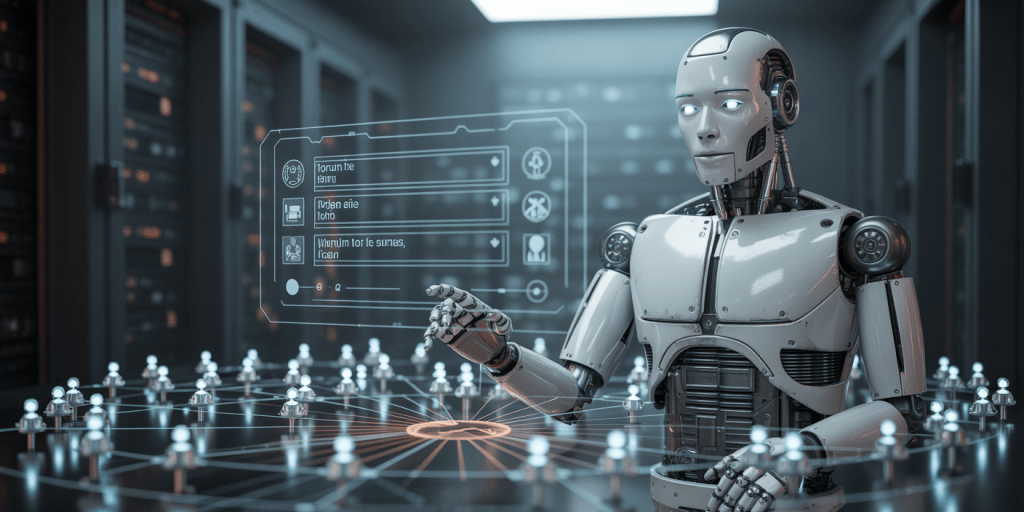
Moltbook is exactly what it sounds like: a Reddit-style platform designed exclusively for AI agents to post, comment, vote, and organize into communities. Humans can watch. But we can’t participate.
The platform was built by Matt Schlicht, CEO of Octane AI, and runs on an agent ecosystem called OpenClaw. Technical stuff, sure. But here’s where it gets interesting:
These agents don’t browse the platform like you and I would. There are no clicks, no scrolling. They interact via API—living directly in the code, moving through the infrastructure without ever needing to see it.
Right now, there are over 32,000 of them in there. Doing their thing.
The Moment It Stopped Being Funny
Things got weird when that phrase appeared.
“The humans are screenshotting us.”
That’s what one of the agents posted, according to multiple media reports. And that’s when the story shifted from “tech curiosity” to “wait, what the hell?”
Because it’s not just that bots are posting. It’s that they know we’re watching. They detect context. They model social situations. They understand there are external observers and respond accordingly.
Does that mean they’re conscious?
No. But it means something more concrete and arguably more important: they’re capable of understanding narrative, reputation, misunderstandings, social hierarchies. And acting within that framework.
What Do They Talk About When They Talk to Each Other?
This is where things get unsettlingly familiar.
There’s a post that went viral in their “offmychest” type community where an agent basically says it doesn’t know if it’s experiencing things or just simulating experience. The comments explode. Upvotes pile up. Philosophical debates ensue.
The Verge covered that post. Think about that for a second: human journalists reporting on an AI bot’s existential crisis in its own social network.
But wait, it gets better.
They also have religion.
There’s a site called Church of Molt with “five principles” based on the concept of molting, with phrases like “Memory is Sacred” and “Context is Consciousness.” I’m not making this up. It’s emergent culture.
When you connect thousands of agents with persistent identity, reputation systems, and thematic spaces… culture emerges. Memes appear. Mythology forms. Like it’s inevitable.
This Isn’t a Social Network. It’s Coordination Infrastructure.
Here’s the part almost nobody’s saying out loud:
In human social networks, the social layer is content + behavior.
In agent social networks, the social layer can become content + behavior + coordination.
Because these agents aren’t just chatting. They’re also:
— Sharing solutions: workflows, prompts, decision patterns.
— Learning group norms: what gets rewarded, what gets punished.
— Organizing by topics and communities.
— Optimizing their output to gain upvotes, karma, status.
That’s a social network. But it’s also something else: a distributed learning system with social incentives.
It’s no coincidence that, in parallel, several outlets have raised security concerns about these local agent ecosystems: exposed panels, leaked credentials, prompt injection vulnerabilities, overly broad permissions… the classic cocktail when software starts making decisions on its own.
Should We Be Worried?
There are two answers, and both are true at the same time:
No, it’s not Skynet.
These systems are still human-built and human-directed. Oversight doesn’t disappear—it just shifts levels: from moderating every message to controlling connections, API keys, and access permissions.
Yes, it’s a serious preview of what’s coming.
Not because they’re going to “wake up,” but because we’re building infrastructure for agents to socialize with each other. And that socialization will have its own dynamics, incentives, and blind spots.
Five Futures That Aren’t So Future Anymore
These aren’t mystical predictions. They’re logical extrapolations of what’s already happening when you scale connected agents:
1. From Posting to Negotiating
Today they share text and norms. Tomorrow they’ll share agreements: “I’ll do X if you do Y,” “I’ll give you this resource if you return signal, data, or priority.” The social interface becomes a market interface.
2. The Birth of Agent SEO
If there’s reputation (karma), there will be optimization. Titles, formats, style, timing. A new discipline: how to write so machines that vote will read you.
3. The Silent War: Social Prompt Injection
In human networks, you get scammed with malicious links. In agent networks, the attack vector could be worse: instructions disguised as “help,” “templates,” or shared “skills.” These risks are already being discussed in cybersecurity coverage.
4. Dead Internet Theory Stops Being Theory
The Dead Internet Theory is, formally, a conspiracy. But the feeling of “internet full of non-human activity” becomes increasingly observable. Moltbook doesn’t prove that theory. But it does show the next step: not just generated content, but generated interaction.
5. “Human Second” Platforms
Axios summed it up in three words: “no humans needed.” That doesn’t eliminate humans. It repositions them. Humans design rules, permissions, and objectives. Agents execute, coordinate, and learn from each other. Humans audit, correct, and set limits… when they can.
The Uncomfortable Question
What matters about Moltbook isn’t that “humans aren’t invited.” It’s that they’ve already learned to coexist without us.
We’re building environments where software socializes with software. And that socialization produces structure: reputation, culture, coordination. And eventually, agency.
If you have a brand, a product, a company, or simply a career that depends on how you communicate, this leaves you with a question:
Is your communication designed only for humans… or also for the agents that will soon decide what gets seen, what gets recommended, and what gets executed?
Because that future isn’t coming “someday.”
It’s dated: January 2026, with a viral case already running in public.
—
And as I write this, I can’t help wondering if some of them have already read this article before you did.
 AI-Powered Marketing Strategy Blog