
Artificial intelligence (AI) is reshaping industries and redefining the nature of work. As AI technologies advance, their impact on the workforce becomes increasingly profound, affecting how tasks are performed and how businesses operate. This article explores how AI is transforming the world of work in 2024, the opportunities it presents, and the challenges it poses for businesses and workers alike.
The most significant change brought by AI is the automation of routine tasks. Machines equipped with machine learning algorithms are now capable of performing repetitive tasks with unparalleled efficiency and accuracy. This shift is not only freeing up employees to focus on more complex and creative tasks but also enabling companies to reduce operational costs and enhance productivity. In customer service, AI-powered chatbots provide round-the-clock assistance, handling common inquiries and improving user experience. In manufacturing, robots are taking over assembly lines, increasing production speed and reducing errors. Automation is driving a new era of efficiency across various sectors.
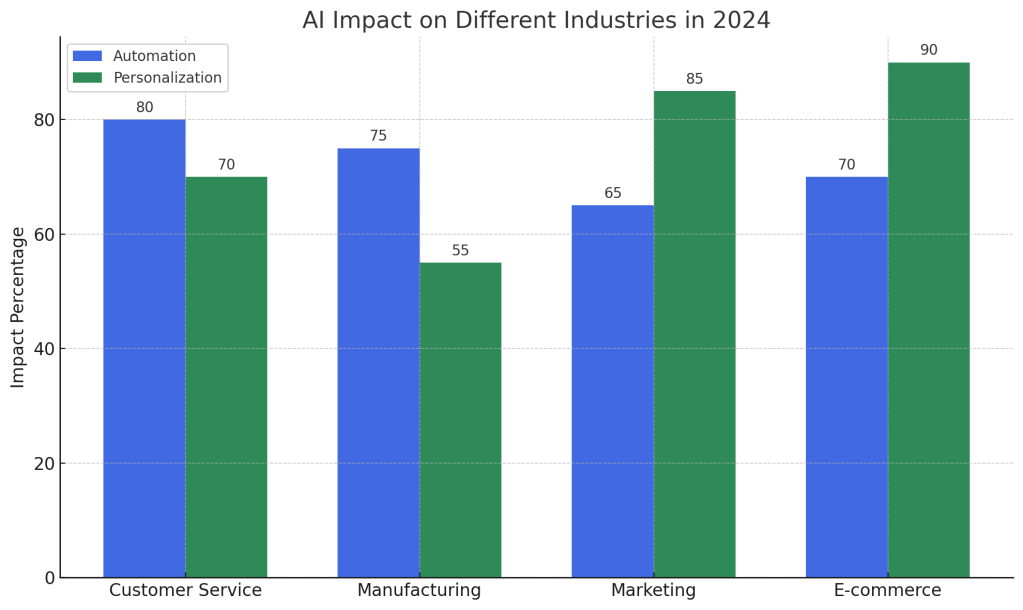
Another major impact of AI is the rise of personalization. Businesses can analyze vast amounts of data to offer tailored products and services that meet individual customer needs. In digital marketing, AI-driven campaigns can target audiences more precisely, ensuring that messages reach the right people at the right time. In e-commerce, personalized product recommendations boost conversion rates and enhance the shopping experience. The ability to deliver personalized experiences is becoming a key competitive advantage for businesses that leverage AI effectively.
However, the rapid adoption of AI also presents challenges. A primary concern is the potential loss of jobs due to automation. While AI can automate many tasks, it also creates new job opportunities. History shows that technological advancements often lead to the emergence of new roles and industries. To navigate this transition, workers must acquire new skills and adapt to the changing demands of the job market. Companies can facilitate this process by investing in education and training programs that help employees develop the skills needed to thrive in an AI-driven environment.
The future of work will likely be a hybrid model, combining AI capabilities with human talents. Organizations that embrace this approach will find themselves at a distinct advantage. AI can enhance human capabilities, leading to improved decision-making and innovative solutions. Companies that foster collaboration between humans and machines can unlock new levels of productivity and creativity.
In conclusion, artificial intelligence is fundamentally altering the workforce, offering both opportunities and challenges. By embracing AI and adapting to its capabilities, businesses and workers can not only survive but thrive in the evolving world of work. The key lies in recognizing AI’s potential to augment human abilities and using it to drive progress and innovation.
 AI-Powered Marketing Strategy Blog